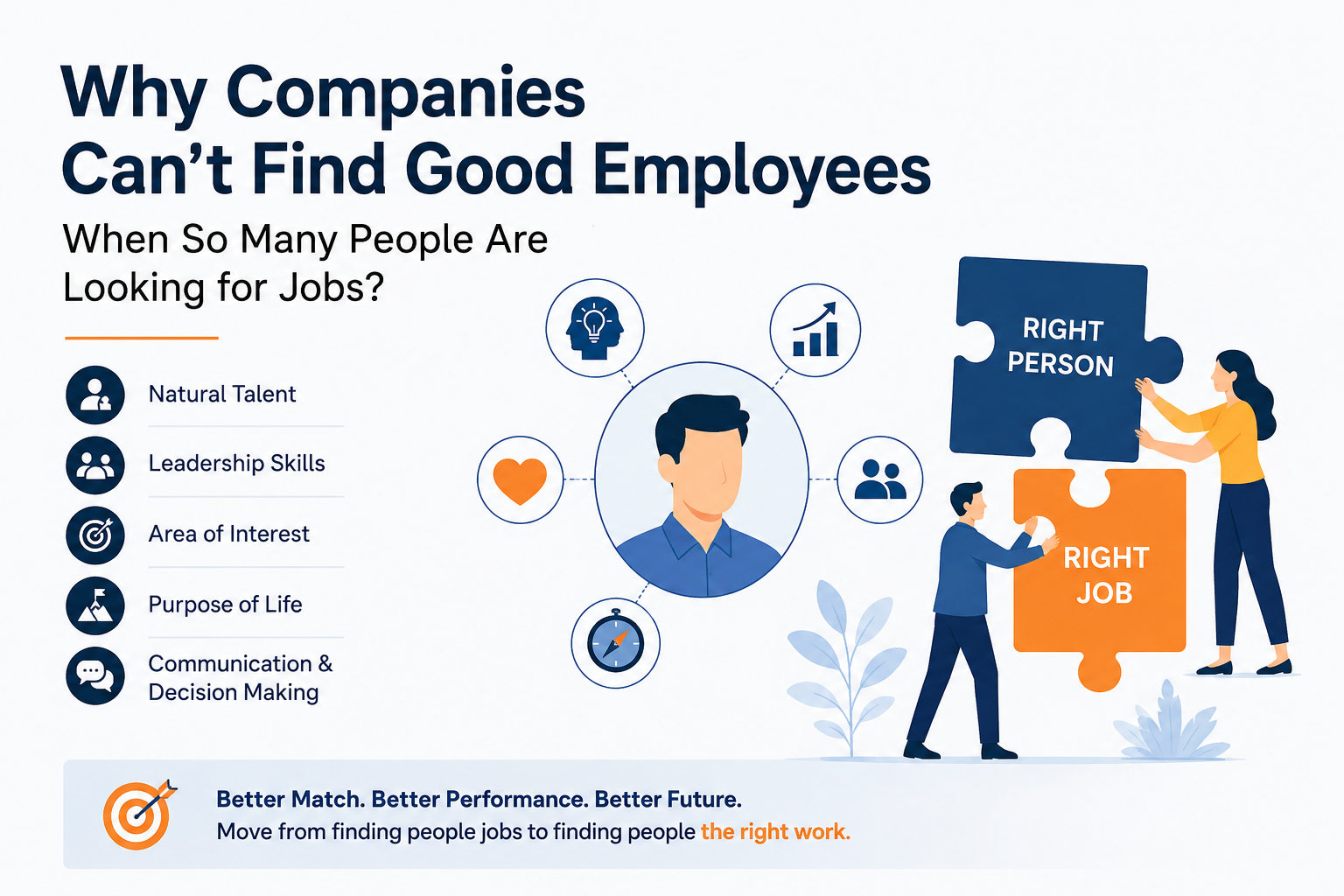
Why do companies say they can't find good employees when so many people are looking for jobs?
Because the problem is often not a shortage of employees. It is a shortage of the right match.
There may be thousands of people looking for jobs and thousands of vacancies, but that doesn't mean the right person is applying for the right job.
I think we have misunderstood recruitment for a long time.
1. People look for jobs, not necessarily the right work
Someone may apply to 20 jobs because they need employment.
But does that person actually have an interest in those jobs?
Does the work match their natural abilities?
Will they enjoy doing it for three years?
These questions are rarely asked.
As a result:
Join → lose interest → poor performance → frustration → leave.
The company then says, "We can't find good employees."
But perhaps the real problem was that the employee was never properly matched with the job.
2. A degree doesn't tell you everything
A degree tells us what someone studied.
It doesn't necessarily tell us whether they are good at:
A person can have an excellent degree and still be completely unsuitable for a particular role.
And someone without an impressive degree can sometimes be extremely good at a particular type of work.
3. We also judge talent incorrectly
This is something I find particularly interesting.
We often judge people based on what we can see.
Someone who talks a lot is considered suitable for sales.
Someone who is quiet is considered unsuitable for sales.
Someone who wants to control things is considered a leader.
But are these assumptions actually correct?
A person who talks a lot may have good communication skills—but that doesn't automatically make them a good salesperson.
A person who wants to lead may have ambition—but ambition doesn't automatically mean leadership ability.
What we see with the naked eye is not always what actually exists inside a person.
4. Leadership is another hidden mismatch
Imagine a cricket team.
Having 11 talented players doesn't guarantee success if you choose the wrong captain.
The same thing happens in companies.
A manager needs more than authority.
They need to understand people, connect with their ambitions, motivate them and bring different personalities together.
Someone can strongly desire to become a leader and still have weak leadership capability.
So companies sometimes promote the person who looks like a leader rather than the person who can actually lead.
5. People also have different purposes
This is another overlooked issue.
A company may want:
Profit + Growth + Productivity
An employee may want:
Recognition + Learning + Satisfaction + Meaning
Neither is wrong.
But if these motivations are completely different, problems can develop.
The employee may think:
"This company doesn't value my ideas."
The company may think:
"This employee isn't interested in performing."
Both may be right from their own perspective.
This is where I think placement needs to change.
Instead of looking only at:
Resume → Degree → Experience → Vacancy
we should also look at:
Person → Natural Talent → Interest → Capability → Motivation → Job
This is the thinking behind Creative Placement.
The idea is to understand things such as:
Company or person check all these reports on creative placement report page before hiring a candidate or before joining a job or role change
Its astrological reports
To check reports click here
https://thecreativeplacement.in/career-reports-new
Here a person can check
1.Natural talent
2.Leadership skill
3.Area of interest
4.Purpose of life
5.Communication skill and decision making
For example, if someone has a strong natural ability for research, putting them into a role that requires completely different capabilities may not produce the best results—even if they have the required degree.
The question should not only be:
"Can this person get this job?"
It should be:
"Is this the right job for this person?"
And for companies:
"Is this the right person for this job?"
That is the real problem.
There aren't necessarily too few employees.
There aren't necessarily too few jobs.
There are often too few good matches between people and jobs.
And I believe the future of placement should move from "finding people jobs" to "finding people the work where they can perform, grow and stay interested."