Software Developer Career Guide: Skills, Job Opportunities, Salary, AI Impact & Step-by-Step Roadmap (2026)
Table of Contents
What is a Software Developer?
A software developer designs, builds, tests, and maintains software applications. These applications may include websites, mobile apps, desktop software, cloud platforms, banking systems, AI tools, games, healthcare software, and enterprise business applications.
Software developers solve real-world problems using programming and technology.
Why Choose Software Development?
Natural Skills Required
A successful software developer usually has these natural abilities:
Simple Description
A software developer enjoys solving problems, understanding how systems work, and building useful applications. They think logically, stay patient while fixing errors, enjoy learning new technologies, and can break complex problems into simple steps.
How to Check Whether Software Development Suits You
Before investing years in learning programming, it is important to know whether your natural abilities match this profession.
1)Professional talent report-if your karma nakshatra is Adra, Mula,shatbistha then you have capabilities of this field. If your karma nakshatra is Chitra then you can go for designing in this field
2)Strong house report-if you have strong house 3rd,5th ,6th and 11th you can go in this field
3)Creativity or Data
Personality report-this report tell you about your working style,
If you like creativity-Develop new software, prefer java
if you like data-go for python
4)Continuous learning-you must check report name your communication skill and decision making on career report page at creative placement. This report tell you how fast you can learn and about analytical skill.
5)Movement Report-This report will tell you weather you have capability of sitting long hours or not
Link- https://thecreativeplacement.in/career-reports-new
All reports are on this page. You can check whether you have skills and interest in this field. If you have the natural talent then you definitely can go.it has high potential
To take promotions for managerial role you must check your management skill. Wisdom report can tell you weather you are suitable for managerial role or not
What Does a Software Developer Do?
Software developers:
Types of Software Developers
Software Engineering Skills
Databases
Cloud Platforms
DevOps Skills
Testing Skills
Performance Testing Software Development Technologies: Role, Applications & AI Impact
|
Technology |
Role |
Main Applications |
AI Impact |
|
Java |
Enterprise programming language |
Banking, ERP, e-commerce, backend APIs, enterprise software |
Low – AI generates code but Java developers are still needed for architecture and business logic. |
|
Python |
General-purpose programming language |
AI/ML, automation, data science, web development, scripting |
Very Positive – AI has greatly increased demand for Python developers. |
|
C# |
Microsoft application development |
Windows software, enterprise applications, Unity game development |
Low – AI speeds up coding but cannot replace developers. |
|
JavaScript |
Frontend web development |
Interactive websites, web applications |
Moderate – AI creates UI code, but developers are needed for complex applications. |
|
TypeScript |
Large-scale JavaScript development |
Enterprise web apps, Angular, React projects |
Low – Demand continues to grow for large projects. |
|
Go (Golang) |
High-performance backend programming |
Cloud computing, microservices, DevOps tools |
Very Low – Growing demand due to cloud infrastructure. |
|
C++ |
High-performance programming |
Game engines, robotics, operating systems, embedded systems |
Very Low – Requires deep expertise that AI cannot easily replace. |
|
SQL |
Database query language |
Database management, reporting, analytics |
Low – AI writes queries but database knowledge remains essential. |
Software Engineering Concepts
|
Technology |
Role |
Main Applications |
AI Impact |
|
Data Structures |
Organize data efficiently |
All software development |
Very Low – Fundamental knowledge cannot be replaced. |
|
Algorithms |
Solve problems efficiently |
Search, sorting, optimization, AI |
Very Low – AI assists but cannot replace algorithmic thinking. |
|
Object-Oriented Programming (OOP) |
Organize software into reusable objects |
Enterprise software, mobile apps, backend systems |
Very Low – Core programming skill. |
|
Design Patterns |
Reusable software design solutions |
Large software projects |
Very Low – Requires architectural understanding. |
|
Software Architecture |
Plan complete software systems |
Enterprise applications, SaaS |
Very Low – Human decision-making remains critical. |
|
System Design |
Design scalable applications |
Large-scale platforms like Amazon, Netflix |
Very Low – One of the highest-value skills in AI era. |
|
API Development |
Connect different software systems |
Mobile apps, websites, SaaS |
Low – AI helps create APIs, but integration and security need developers. |
|
Microservices |
Build software as independent services |
Cloud-native applications |
Low – AI speeds development but architecture remains human-driven. |
Databases
|
Technology |
Role |
Main Applications |
AI Impact |
|
MySQL |
Relational database |
Websites, ERP, CRM |
Low – Database design remains important. |
|
PostgreSQL |
Advanced relational database |
Enterprise software, analytics |
Low – Demand continues to grow. |
|
SQL Server |
Microsoft enterprise database |
Banking, healthcare, ERP |
Low – AI assists administration only. |
|
MongoDB |
NoSQL database |
Social media, IoT, big data |
Low – Developers are still needed for schema and optimization. |
|
Redis |
In-memory database/cache |
Caching, real-time applications |
Very Low – High demand for scalable systems. |
Cloud Platforms
|
Technology |
Role |
Main Applications |
AI Impact |
|
AWS |
Cloud infrastructure |
Hosting, storage, AI, DevOps |
Very Positive – AI workloads increase AWS demand. |
|
Microsoft Azure |
Enterprise cloud platform |
Business applications, Microsoft ecosystem |
Very Positive – Strong enterprise demand. |
|
Google Cloud Platform (GCP) |
Cloud & AI platform |
Data analytics, AI, machine learning |
Very Positive – Growing rapidly because of AI services. |
DevOps
|
Technology |
Role |
Main Applications |
AI Impact |
|
Git |
Version control |
Source code management |
Very Low – Essential for all developers. |
|
GitHub |
Code hosting & collaboration |
Team development, open-source projects |
Low – AI Copilot enhances productivity. |
|
GitLab |
DevOps platform |
Source control, CI/CD |
Low – AI assists workflows but doesn't replace engineers. |
|
Docker |
Containerization |
Deploy applications consistently |
Very Low – Critical for modern software deployment. |
|
Kubernetes |
Container orchestration |
Cloud-native applications |
Very Low – High-demand infrastructure skill. |
|
Jenkins |
Automation server |
Build and deployment automation |
Moderate – AI simplifies pipelines but engineers manage them. |
|
CI/CD Pipelines |
Automated software delivery |
Continuous integration and deployment |
Low – AI helps create pipelines but operations expertise remains necessary. |
Software Testing
|
Technology |
Role |
Main Applications |
AI Impact |
|
Unit Testing |
Test individual functions |
Software quality assurance |
Moderate – AI can generate test cases, but validation is required. |
|
Integration Testing |
Test interaction between systems |
Enterprise software |
Low – Human oversight is still essential. |
|
Automation Testing |
Automate repetitive testing |
Web, mobile, enterprise applications |
Moderate – AI improves automation but testers remain important. |
|
Performance Testing |
Measure speed and scalability |
High-traffic websites, cloud applications |
Low – Performance analysis and optimization require engineers. |
Future-Proof Skills (Least Affected by AI)
These skills involve system-level thinking, architecture, and decision-making, which AI currently assists with but does not replace.
AI Skills Every Developer Should Learn
Software Development Tools
Development
Version Control
Database
Cloud
Project Management
Industries Hiring Developers
|
Industry |
Demand |
|
IT Services |
⭐⭐⭐⭐⭐ |
|
SaaS |
⭐⭐⭐⭐⭐ |
|
Banking |
⭐⭐⭐⭐⭐ |
|
Healthcare |
⭐⭐⭐⭐ |
|
E-commerce |
⭐⭐⭐⭐⭐ |
|
Education |
⭐⭐⭐⭐ |
|
Automobile |
⭐⭐⭐⭐ |
|
Manufacturing |
⭐⭐⭐⭐ |
|
Telecom |
⭐⭐⭐⭐ |
|
Government |
⭐⭐⭐⭐ |
Job Opportunities
Entry Level
Mid Level
Senior Level
Leadership
Step-by-Step Learning Roadmap
Stage 1 (Month 1)
Learn
Stage 2 (Months 2–3)
Choose one language
Learn
Stage 3 (Month 4)
Learn
Practice coding daily.
Stage 4 (Month 5)
Learn
Stage 5 (Months 6–7)
Learn
Stage 6 (Months 8–9)
Learn
Stage 7 (Months 10–11)
Learn
Stage 8 (Month 12)
Build
Daily Responsibilities
Best Books
Best Institutes
Degree Programs
Online Platforms
Alternative Learning
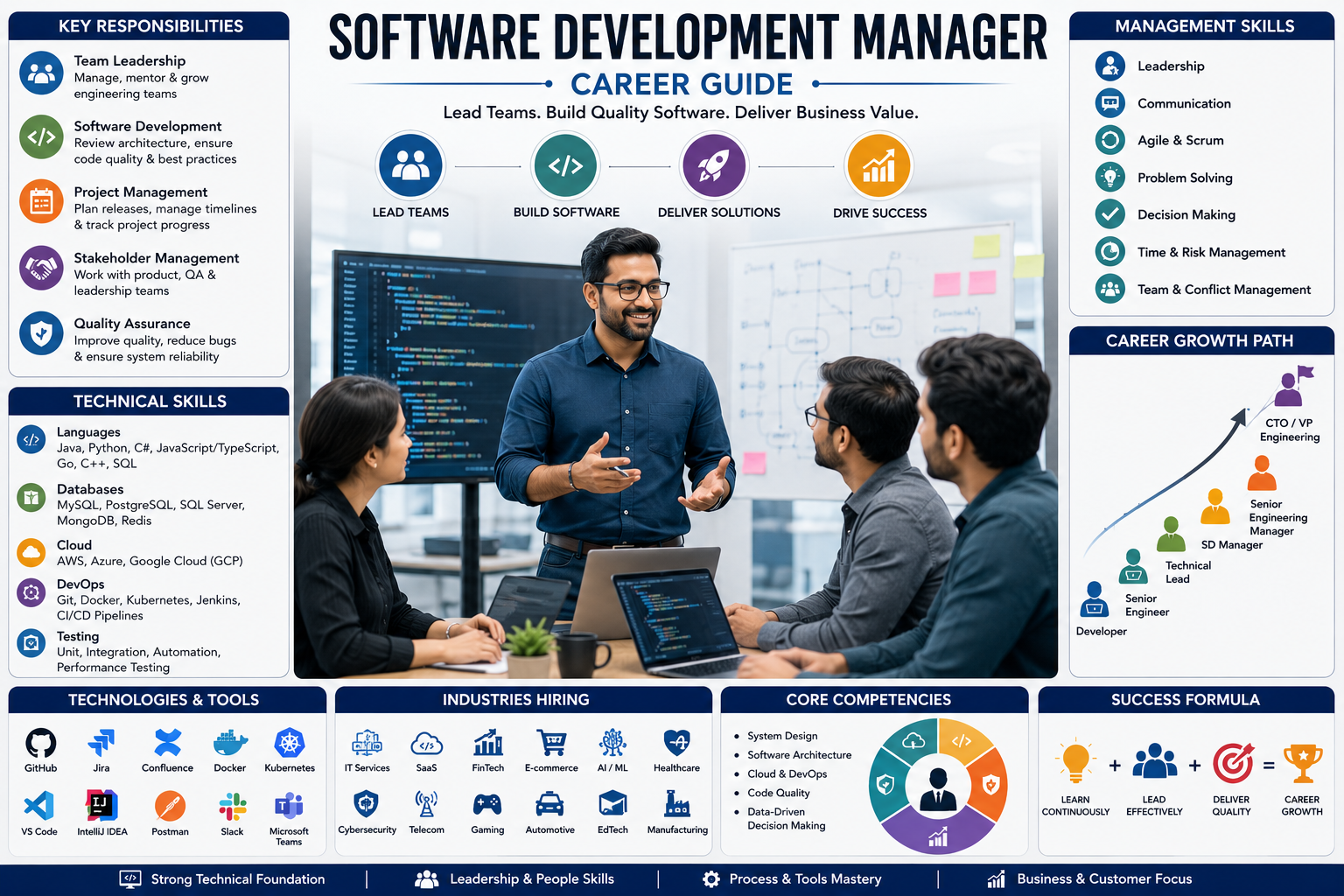
Career Growth
Intern
↓
Junior Developer
↓
Software Developer
↓
Senior Software Engineer
↓
Technical Lead
↓
Engineering Manager
↓
Senior Engineering Manager
↓
Director Engineering
↓
Vice President Engineering
↓
Chief Technology Officer (CTO)
Salary Hierarchy (India)
|
Position |
Experience |
Salary (LPA) |
|
Intern |
0 |
₹2–6 L |
|
Junior Developer |
0–2 yrs |
₹4–8 L |
|
Software Developer |
2–4 yrs |
₹6–12 L |
|
Senior Developer |
4–6 yrs |
₹10–18 L |
|
Software Engineer |
5–8 yrs |
₹15–25 L |
|
Technical Lead |
6–10 yrs |
₹18–35 L |
|
Engineering Manager |
8–12 yrs |
₹25–45 L |
|
Senior Engineering Manager |
10–15 yrs |
₹35–60 L |
|
Director Engineering |
12–18 yrs |
₹50 L–₹1 Cr |
|
VP Engineering |
15+ yrs |
₹80 L–₹1.8 Cr |
|
CTO |
15+ yrs |
₹1–3 Cr+ |
Future Scope
The future of software development remains strong. AI is changing how developers work, not eliminating the profession. Developers who combine programming with AI, cloud computing, cybersecurity, and system design will continue to be in high demand. Companies increasingly value engineers who can solve business problems, design scalable systems, and integrate AI into real-world applications rather than only writing code.
Frequently Asked Questions (FAQs)
Is software development a good career in 2026?
Yes. It remains one of the highest-paying and fastest-growing careers, especially for developers skilled in AI, cloud, and backend systems.
Which language should beginners learn?
Python is often the easiest starting point, while Java is an excellent choice for enterprise software and large-scale applications.
Is AI replacing software developers?
No. AI automates repetitive coding tasks, but skilled developers are still needed for architecture, product design, security, and solving complex business problems.
Do I need a computer science degree?
No. Many successful developers learn through online courses, open-source contributions, personal projects, internships, and coding bootcamps. Employers increasingly value demonstrable skills and portfolios alongside formal education.